
The B2B Ombuds is a game-changer that fixes issues before they grow to be expensive problems.
ADRx3 identified a gap in commercial contracting: Enterprise value rarely disappears in a courtroom; it slips away during early operational friction before formal legal notices are ever exchanged. Traditional dispute resolution steps in after relationships break down. We designed a cost-effective upstream alternative for dispute prevention. B2B Ombuds services are confidential, impartial, and independent, plus conversations are off-the-record, protected by the same laws that protect mediation.
On-Demand Business-to-Business Ombuds
What is it?
An independent, confidential safety valve built into commercial agreements. It gives delivery partners an off-the-record venue to resolve operational friction and preserve collaboration before formal notices are filed.
How does it work?
Embed upfront: Add a dormant B2B Ombuds clause into master service agreements with zero ongoing retainer.
Reach out confidentially: Either partner can contact the B2B Ombuds unilaterally and off the record without triggering formal legal notice.
Realign delivery: Using commercial and ADR insight, the B2B Ombuds diagnoses friction points and conducts private shuttle diplomacy.
Return to progress: Both parties adjust schedules or scope collaboratively to keep the engagement moving forward.
How much does it cost?
Zero monthly retainer: The B2B Ombuds clause remains dormant in your contract at no cost until activated.
Pay only for active hours: Fees apply exclusively when a party activates dispute prevention support.
Shared investment: Intake is borne by the initiating party until joint shuttle facilitation begins, at which point fees are typically shared equally.
Where can I learn more?
A comprehensive overview:
Articles from our blog:
1) Model and ROI
2) Deals and Governance
3) Partners & Vendors
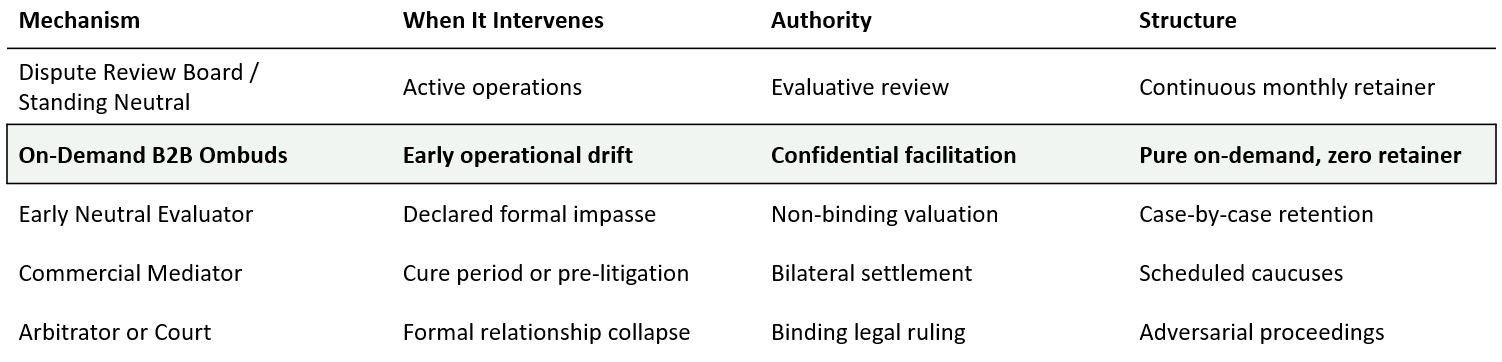
How is it different?
Standard contract governance mechanisms fail to protect interdependent operations:
The Cost of Silence: Operational teams hide delivery slippage or scope creep because sending formal legal notices instantly freezes communication and damages relationships.
The Positional Trap of Escalation Ladders: Escalating an issue to executive sponsors often hardens negotiating postures rather than uncovering underlying technical or resourcing roadblocks.
The Absence of a Neutral Safety-Valve: Without an off-the-record venue, operational leads have nowhere to reality-check trade-offs confidentially before positions become intractable.